
 United Kingdom
 Ireland
 The Netherlands
 Belgium
 Italy
Italy Germany
 Luxembourg
 Switzerland
 Middle East
 Saudi Arabia
 Bahrain
 Oman
Oman Kuwait
 Qatar
Qatar
Finding a temporary cooling solution can be a daunting challenge, particularly if your requirement is of an urgent nature. With this in mind, the team at Andrews Chillers has created a short video that explains the functionality of chillers and how to guarantee the perfect outcome for your cooling application.
The aim of the video is to give our customers a better understanding of the chiller units we offer and explain how they apply to different environments. The video shows how you can overcome your cooling challenges while discussing the various types of cooling. These include comfort cooling, high capacity cooling and process cooling.
Using sample scenarios, the animation demonstrates the specific process that a unit goes through to provide the cooling for your requirement.
Unlike a standard air conditioner, a chiller cools a fluid rather than air directly. The chilled fluid is distributed through pipework to buildings or processes that require cooling. Common applications include chillers for hospitals and healthcare, hotels, facilities, and food production facilities.
A single external chiller unit can cool an entire building or support temperature-critical processes. It can also connect directly to existing pipework, providing a rapid replacement for a failed permanent chiller.
How does a Chiller Actually Work?
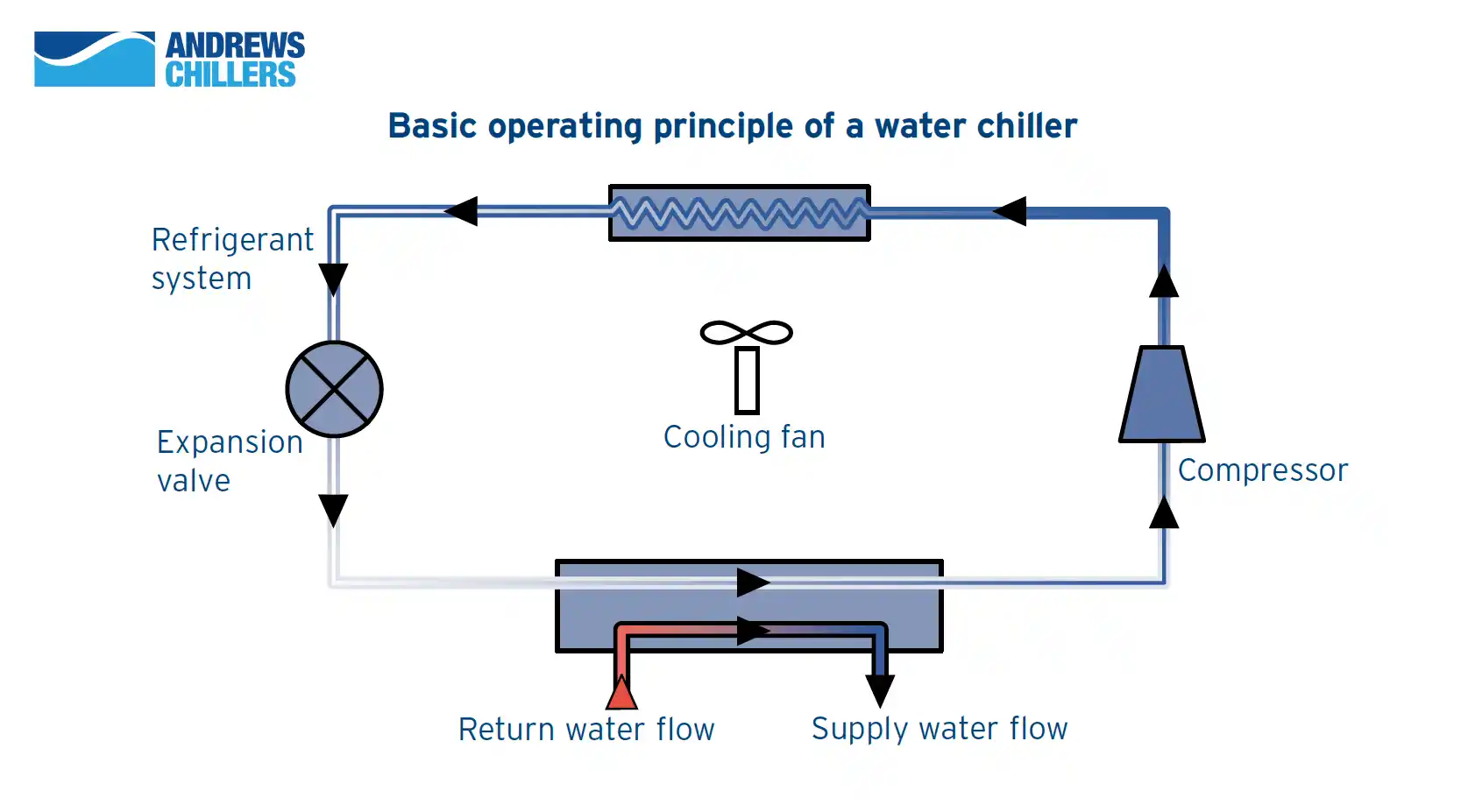
Every chiller, regardless of size or application, runs on the same four-stage refrigeration cycle. The animation in the video shows this in action; here is what is happening at each stage:
- The compressor pressurises refrigerant gas, raising its temperature.
- The hot refrigerant passes through the condenser. All Andrews Chillers units are air-cooled: integral fans blow ambient air across the condenser coil, rejecting heat to the atmosphere. This design eliminates the need for a cooling tower or permanent water supply.
- The liquid refrigerant then passes through an expansion valve. This sharply reduces its pressure and temperature, creating the cooling effect delivered by the system.
- The cold refrigerant enters the evaporator heat exchanger, absorbing heat from the chilled water circuit and cooling it. That chilled water circulates to wherever the cooling is needed – fan coil units, air handling units, or process equipment. Warmed return water flows back to the evaporator, and the cycle repeats continuously.
The Three Types of Chiller Cooling and Which One You Need
Comfort cooling is designed to regulate temperature and improve occupant comfort. Understanding how different cooling systems work can help you select the most suitable solution for your environment.
1. Comfort cooling
This type of chiller is normally used in
- Hospitals
- Hotels and resorts
- Offices and chillers for the facility management sector
- Schools and universities
These sectors require an accurate temperature control as a system failure can directly influence the satisfaction of building occupants. Temporary chiller hire is most commonly triggered here by planned maintenance shutdowns or unexpected equipment failures.
A recent project completed by our dedicated team (Andrews Chillers Keeps Sterile Centre Operating 24/7 After Cooling Failure) demonstrates the value of this type of cooling support. We supplied a 250 kW Fluid Chiller to a sterile services centre after a critical cooling system failure. The facility relied on precise temperature control to maintain sterilisation processes. An immediate replacement solution was essential to maintain compliance with healthcare standards.
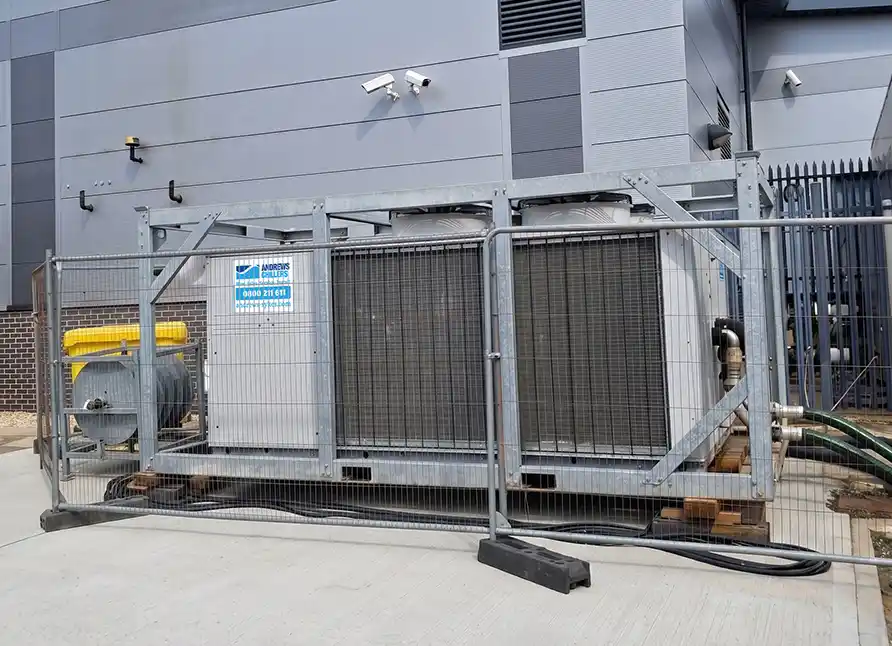
Our temporary chiller was rapidly installed and connected to the site’s existing air handling units, restoring stable environmental conditions and allowing the centre to continue operating 24/7 without disruption. More than a year later, the unit remains on site, continuing to provide reliable cooling and supporting the uninterrupted delivery of critical healthcare services.
Temporary cooling solutions also play a vital role in commercial environments. In another recent project, we provided a 750 kW unit to support a with a chiller hire solution for hotel while it underwent a major refurbishment. The hotel in question was looking to replace their air conditioning system during a peak period but the presence of guests meant a substitute system was imperative. Our temporary chiller was able to keep the hotel cool in the meantime and guaranteed business continuity for a major customer.
2. High-capacity cooling
As well as comfort cooling, the video explains what to do if you need to cool larger areas, including chillers for film and TV production studios, storage facilities and warehouses. In this scenario, the solution would be to acquire a high capacity chiller. These units are placed outside the targeted building and are then connected to a series of air handlers with cool air then ducted into the building.
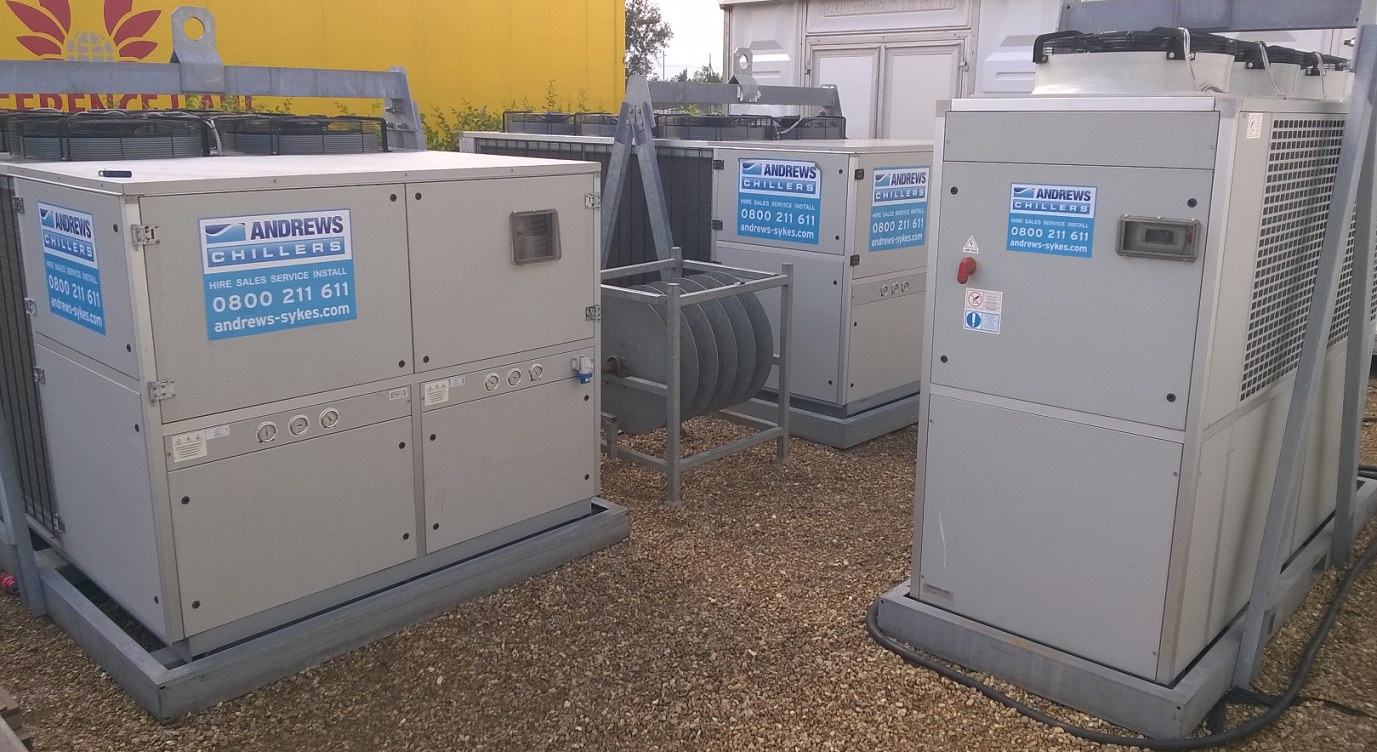
A recent job carried out by our experts encapsulates the value of a high capacity chiller which provided a perfect solution to a client’s cooling issue. The customer was responsible for a large print company in the South East of England and in urgent need of a short-term cooling solution during the middle of a heatwave. A chiller connected to a temporary air handler was recommended and installed by our local specialist which ensured that thousands of pounds’ worth of heavy duty equipment was not damaged due to overheating.
3. Process cooling
The third most common type of cooling solution documented within the video is process cooling. As a company, we understand the critical nature of food and beverage industries or pharmaceutical applications that are dependent on lower temperatures. These types of industries require the most reliable, energy efficient fluid chiller hire units because of their propensity to be in use for extensive periods of time. This type of chiller is used when a product cannot come into contact with the actual refrigeration process, making them the perfect option when cooling is necessary.
Process chillers in the Andrews Chillers fleet operate at fluid supply temperatures from +6°C down to −15°C. This range covers applications from chilled water for food production to deep-freeze glycol circuits used in pharmaceutical cold storage.
Choosing the right size matters significantly in process cooling. A 100 kW chiller suits smaller food production lines and single fermentation vessels. A 200 – 550 kW unit is often more appropriate for mid-sized dairies and multi-vessel breweries. For continuous production cooling, larger facilities typically use 750 kW+ packages.
Our team can help you determine the correct specification through a free site survey, ensuring your cooling system meets operational demands. For ongoing process cooling requirements, visit our dedicated process cooling hire page, or explore our solutions for chiller hire for food and beverage manufacturers.
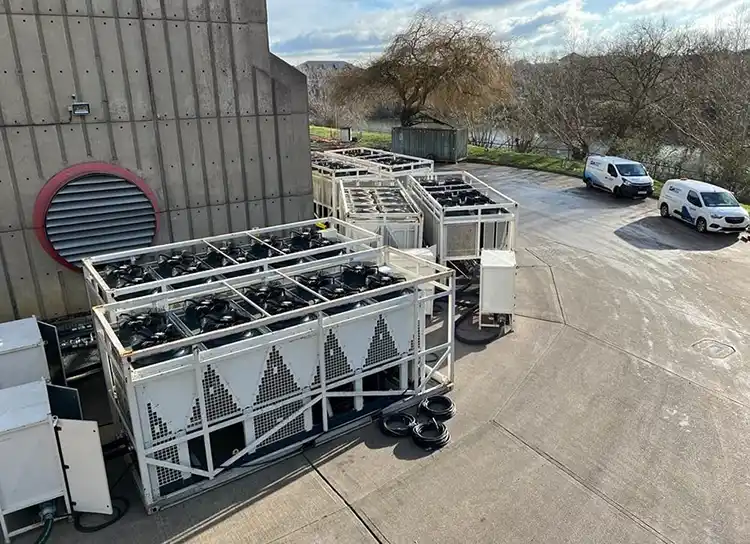
A recent case study carried out by Andrews Chillers highlights the importance of process cooling in one of the country’s largest breweries. The company – one of the world’s largest beer manufacturers – was minutes away from having to halve its entire production line due to excessive temperatures inside the factory. If production had stopped as feared, it would have cost drink manufacturers hundreds of thousands of pounds during this period, which would have been a catastrophic side-effect. To prevent this, we provided out-of-hours intervention to assist them with their issue and installed six 750kW fluid chillers to ensure temperatures remained at -5°C.
When Does a Business Need to Hire a Chiller?
| Planned maintenance and shutdowns | When a permanent chiller plant is taken offline for scheduled servicing, regas, or replacement, a temporary chiller hire unit maintains cooling continuity. Good M&E contractors plan this months in advance, arrange delivery on a specific date, and return the unit as soon as the permanent plant is recommissioned. |
| Emergency breakdown | When a permanent chiller fails unexpectedly, the consequences are immediate overheating processes, uncomfortable or unsafe building temperatures, and potential product loss. Emergency chiller hire from Andrews Chillers is available 24/7/365, with a guaranteed four-hour response from our nationwide depot network. Same-day deployment is standard. |
| Seasonal production surges | Food and beverage manufacturers, breweries, and pharmaceutical producers often require additional temporary cooling capacity during summer months or during peak production runs, when fixed plant is at full capacity but demand temporarily exceeds it. |
| Construction, fit-out and commissioning | When a building’s permanent mechanical plant has not yet been commissioned, or is temporarily out of service during a fit-out, temporary portable chiller hire provides essential cooling. This is especially common in NHS trusts, large commercial developments, and data centre construction projects. |
When hiring a chiller, it is important to consider how an arrangement will help you obtain the best results. By putting your trust in a reliable service, you can secure an immediate solution. When things do not go to plan or if a system failure is unexpectedly encountered.
Not Sure Which Unit is Right for You? Our Specialists Can Help
If you’re unsure which chiller solution is the most befitting for your application, don’t worry! Our trained specialists have had decades of experience in the chiller hire industry. This expertise allows them to propose the best solution every single time. We provide free site surveys to alleviate the concerns of our clients by demonstrating how we’ll go about overcoming whatever challenge you encounter.
|
Our nationwide depot network and 24/7/365 service mean we can reach any location within four hours of enquiry.
Call us today on 0800 211 611 |
|---|
FAQs
What is the difference between a chiller and an air conditioner?
An air conditioner cools air directly in a room using a refrigerant-to-air heat exchanger. A chiller cools water or glycol. It then pumps the fluid through pipework to fan coil units, AHUs, or process equipment. Businesses rely on chillers for large-scale cooling and multi-zone applications. They are also ideal where products must never come into contact with refrigerant, unlike a standard air conditioner.
How quickly can a hired chiller be delivered?
Andrews Chillers operates 24/7/365 with a four-hour response from depots nationwide. Standard comfort cooling deployments onto existing fan coil pipework are typically operational the same day. Process cooling installations using plate heat exchangers require flow-rate data and a system diagram. Our engineers confirm a precise timeline during the initial call.
How do I know what size chiller I need?
The starting point is your heat load: the amount of heat your space or process generates, measured in kW. As a rough guide, allow 30 – 50 kW for small commercial or light process applications. Around 100 kW is suitable for hospitals, large offices, or food production lines.
Our engineers are available 24/7/365 to support your cooling needs. We also provide free site surveys to identify the right solution for your application. This ensures you receive equipment that is correctly sized, energy efficient, and capable of meeting your operational demands.